Warriors Dream Series is betting that India breaks through on the back of a home-grown promotion — not an imported one. Global MMA is now a 6-7 billion-dollar business.
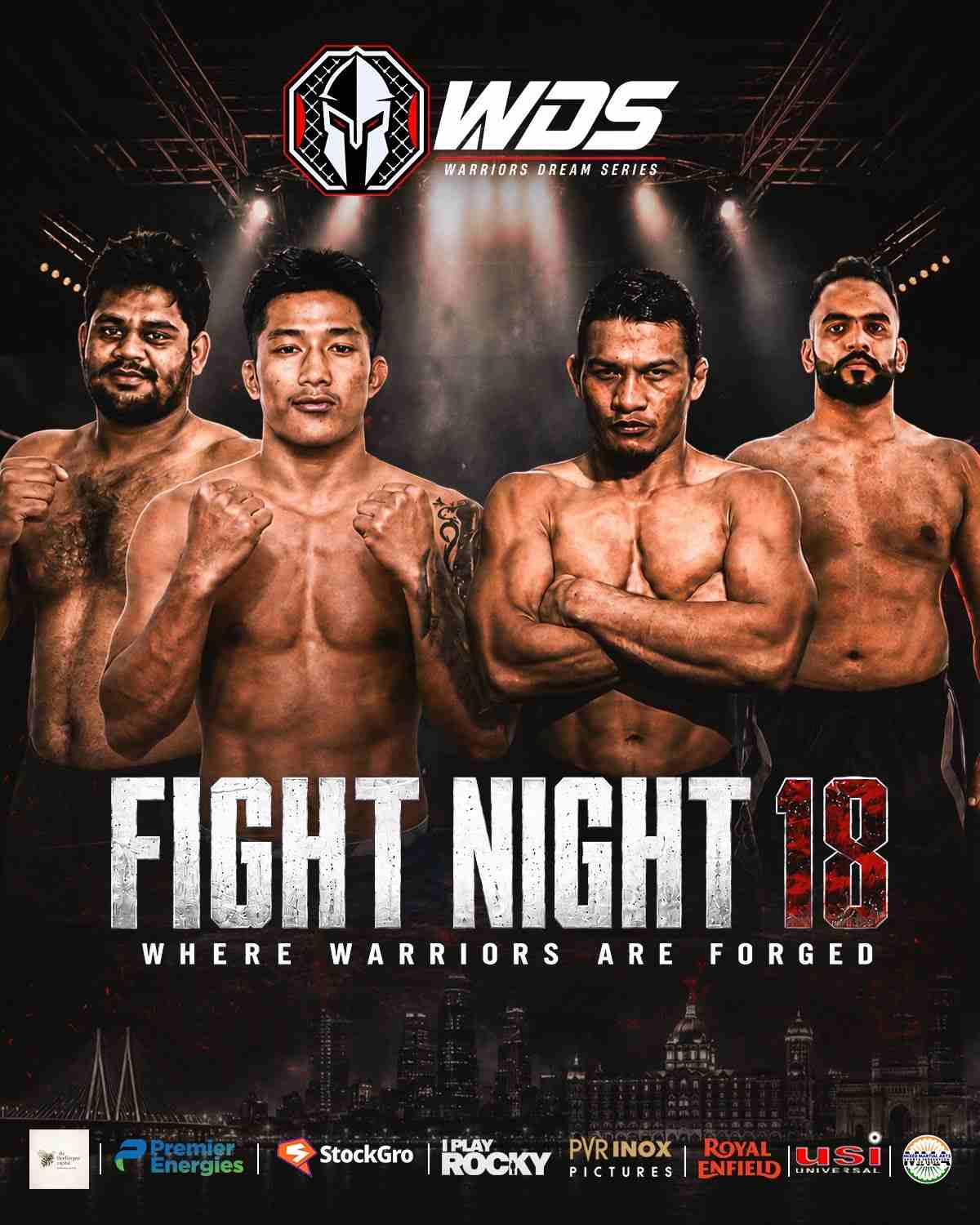
On the last Saturday of August, around a thousand people will pack into the CIDCO Convention Centre in Mumbai, built around a single question: How good has Indian MMA actually become? The answer arrives across 13 professional bouts on 29th August, in the form of fighters flown in from around Asia — three India-versus-Philippines match-ups and two India-versus-Russia among them — with a livestream running past four hours to carry the night well beyond the arena.
This is Fight Night 18, the latest edition of Warriors Dream Series (WDS), and it doubles as a snapshot of how far a domestic promotion can travel in a little over five years.
WDS has run since April 2022. In that stretch it has staged 24 editions and put on more than 1,800 professional and amateur bouts — a volume of matchmaking that, in a country where organised MMA barely existed a decade ago, adds up to a competitive pipeline built almost from scratch. Emerging fighters get their first professional tests here; established ones get the regular. Fight Nights are where elite professionals bring the war to the cage; India’s Rising Stars is where amateur fighters get their first taste of competition — a national championship pathway in its own right.
Sports properties rarely become valuable through one-off spectacles. They grow through recurring events, recognisable names, rivalries that mean something, and the storytelling and broadcast that let fans follow a fighter from a small hall to a big stage. Consistency, not any single knockout, is the asset.
“Every edition is a chance to raise the bar. Fight Night 18 brings stronger international competition onto Indian soil, real opportunity for our athletes, and a card our fans will remember. Thirteen bouts, fighters flying in from across Asia — this is another serious step in building the scale and credibility of MMA in this country. We’re building something Indian fighters can truly call their own.”
— Sanjivan Padwal, Founder, Warriors Dream Series
For a long time, MMA in India lived on the fringes — a passionate but small world of events and gyms, fighters and hardcore fans, largely invisible to the mainstream. That is changing. Bigger cards, international opponents, cleaner production and digital streaming have started to nudge the sport from a niche combat circuit towards organised spectator entertainment.
The tailwind behind that shift is hard to overstate. Globally, the transformation has already happened. UFC now describes itself as having more than 700 million fans and 250+ million social-media followers, producing over 40 live events a year and reaching 900 million-plus television households across 170 countries. The commercial scale matches the reach: parent TKO Group Holdings reported UFC revenue of roughly US$1.50 billion in 2025, up from US$1.41 billion the year before. (UFC · TKO Group Holdings) 1 year before, the market-cap of over US$35 Billion dollars.
India sits far earlier on that curve — but the appetite is already showing up in the data. SonyLIV’s UFC viewership in the country grew more than 80% year-on-year, with video views and watch time up 63% over April–July FY2027. (ETBrandEquity) UFC’s broadcast tie-up with Sony Pictures Networks India, extended through 2028, now carries English, Hindi, Tamil and Telugu feeds — a telling sign of the push to take the sport past a metropolitan, English-speaking core.
Indian fighters are giving those audiences reasons to stay. Anshul Jubli became only the second India-born athlete to reach the UFC after winning Road to UFC. Puja Tomar became the first Indian woman to enter the promotion, then the first Indian to win a UFC bout. Breakthroughs like these do the work no marketing budget can — they give fans someone to follow.
But a handful of global stars can’t carry a sport on their own. They need a base beneath them: regular fights, professional matchmaking, athlete development, international exposure, and platforms where fans can actually watch the journey unfold. That base is precisely what a promotion like WDS is trying to lay down, card after card, at home.
“Fight Night was never meant to be a one-off. We’re building a consistent platform that brings athletes, fans and partners back edition after edition. With every card, the scale grows and the international field gets deeper. The ambition is simple and it is big: build a globally recognised MMA promotion out of India — one that can one day stand shoulder to shoulder with the biggest names in the sport.”
— Sudhanshu Srivastav, Co-Founder & Promoter, Warriors Dream Series
India is unlikely to build its “own UFC” by photocopying the UFC. It will need an ecosystem shaped to its own audiences — Asian and local heroes, rivalries, fights that travel to more than one city, brands and broadcasters willing to invest, and fans who come to read the sport as technique, conditioning and strategy rather than raw aggression.
The ingredients are starting to line up: Indian fighters reaching the biggest stages, digital consumption climbing fast, and domestic promotions manufacturing the one thing that was always missing — regular, professional competition. The cage is still a niche arena in India. The crowd forming around it is not planning to stay small.